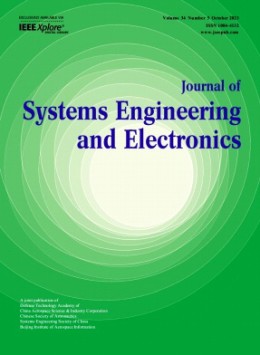
《Journal of Systems Engineering and Electronics》雜志是什么級(jí)別?雜志刊期是多久?
來(lái)源:優(yōu)發(fā)表網(wǎng)整理 2025-12-15 15:06:26 3401人看過
《Journal of Systems Engineering and Electronics》雜志級(jí)別為SCI期刊。目前刊期為雙月刊。
《Journal of Systems Engineering and Electronics》雜志簡(jiǎn)介信息
《Journal of Systems Engineering and Electronics》是《中國(guó)科學(xué)引文數(shù)據(jù)庫(kù)》來(lái)源期刊,被美國(guó)科學(xué)引文索引(SCIE)、美國(guó)工程索引(EI)和英國(guó)科學(xué)文摘(SA)等多家國(guó)內(nèi)、外著名檢索系統(tǒng)收錄。
《Journal of Systems Engineering and Electronics》是面向高科技開發(fā)和應(yīng)用的跨學(xué)科期刊,以傳播新技術(shù)、促進(jìn)學(xué)術(shù)交流為宗旨,堅(jiān)持深度與廣度、理論與應(yīng)用相結(jié)合的方針,努力反映系統(tǒng)工程與電子技術(shù)兩大領(lǐng)域的最新成就,報(bào)道的主要內(nèi)容包括:系統(tǒng)科學(xué)、軍事系統(tǒng)分析、飛行器控制、雷達(dá)、光電探測(cè)技術(shù)、信息獲取與處理、運(yùn)籌學(xué)管理與決策技術(shù)等。
《Journal of Systems Engineering and Electronics》雜志特色:
Aims and scope
The journal, keeping abreast with the development trend of science and technology worldwide, reports the latest developments and achievements in systems engineering and electronics and related research areas, and encourages various academic views. The journal welcomes papers from a wide variety of countries.
The journal strives to publish high-quality papers reporting original work in both theoretical and practical research results within the journal scope, involving system analysis, system modeling and simulation, military system analysis, aircraft control, C3I, radar, information systems engineering, machine intelligence, artificial neural networks, information acquisition and processing, aerospace electronics, and other topics in all related fields.
Title
The title is centered on the page and should be short and concise. Please limit the title to a maximum length of 10 words. The author’s name follows and is also centered on the page. The author’s last name should be preceded by the other names spelled out in full. The author’s affiliation and address are also needed.
The corresponding author should be clearly indicated with the asterisk (i.e., *) and given on the bottom of the first page. Please provide the financial support acknowledgments (name and number) on the bottom of the first page.
Abstract
An abstract, not exceeding 200 words, is required for all papers. Acronyms and abbreviations are spelled out at first mention in the abstract. It should be a summary of the paper and not an introduction. Because the abstract may be used in abstracting journals, it should present concisely the purposes, methodology used, results obtained, and conclusions.
Keywords
The author must provide a list of keywords, up to a maximum of six. No acronyms and abbreviations should be used.
Text
Text should be typed in double-column. The introduction of paper should explain the nature of the problem, previous work, purpose, and contribution of the paper. It is assigned the number “1” and following sections are assigned number as needed. For example, the third section of a paper might be “3. Simulation results” headings. Acronyms and abbreviations are spelled out at first mention in the text, even they have already been defined in the abstract.
Figures and tables
The authors must ensure figures of sufficient quality and resolution. Figure captions appear below the figures. Figures should be numbered in the order they appear in the text. Table titles appear above the tables. Please verify that the figures and tables you mention in the text actually exist. When referring to a figure or a table in the text, use the abbreviation “Fig.” even at the beginning of a sentence, and do not abbreviate “Table”.
Equations
Number equations consecutively with equation numbers in parentheses flush with the right margin, as in (1). Be sure that the symbols in the equation have been defined before the equation appears or immediately following. When referring to “(1)”, do not use “Eq. (1)” or “equation (1),” except at the beginning of a sentence: “Equation (1) is ...”.
Conclusion
A conclusion must be included and should indicate clearly the advantages, limitations, and possible applications of the paper.
Acknowledgment
Individuals or units other than authors who were of direct help in the work should be acknowledged by a brief statement following the conclusion. This heading is not assigned a number.
References
Only articles that have been published may be included in the references. Each reference is referred to in the text by a number enclosed in a square bracket (i.e., [3]). References must be numbered and ordered according to where they are first mentioned in the paper. A reference list must be included using the following information as a guide.
Biographies
Short biographies (120-150 words) should be provided that detail the authors’ education, work histories and research interests as well as their E-mail. The authors’ full names are needed. Small (2.5 cm×3.5 cm), black-and-white and high- resolution (300 dpi) photos of each author should be included.
聲明:以上內(nèi)容來(lái)源于互聯(lián)網(wǎng)公開資料,如有不準(zhǔn)確之處,請(qǐng)聯(lián)系我們進(jìn)行修改。