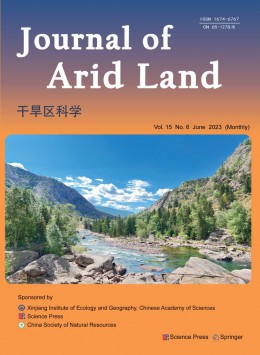
《Journal of Arid Land》雜志是什么級別?雜志刊期是多久?
來源:優(yōu)發(fā)表網(wǎng)整理 2025-12-15 15:06:25 2819人看過
《Journal of Arid Land》雜志級別為CSCD期刊、統(tǒng)計源期刊、SCI期刊。目前刊期為雙月刊。
《Journal of Arid Land》雜志簡介信息
《Journal of Arid Land》(簡稱JAL)是中國科學院新疆生態(tài)與地理研究所和科學出版社聯(lián)合主辦、科學出版社出版的自然科學綜合性學術季刊。
《JournalofAridLand》刊登干旱和半干旱地區(qū)水、土、生物、氣候等自然資源變化及其大氣圈、水圈、生物圈、巖石圈之間的相互作用和與人類活動的關系,干旱和半干旱地區(qū)地理、生態(tài)和環(huán)境格局及生態(tài)建設和環(huán)境保護,干旱和半干旱區(qū)域對全球變化的響應與反饋機制等原創(chuàng)性、綜合性、理論性和實用性的研究成果.
《Journal of Arid Land》本刊還開展中亞地區(qū)資源環(huán)境、生態(tài)安全及區(qū)域可持續(xù)發(fā)展的國際學術交流;同時刊登上述方面的研究評述、快訊、學術動態(tài)及本領域重要參考書書評等。本刊主要設有學術論文、專題評述、研究簡訊、學術動態(tài)、書評等五個欄目,以國內外從事干旱區(qū)自然地理、生物、土壤/土地資源、環(huán)境、氣候、水文水資源、社會科學等方面研究的專家學者,以及這些領域教學和學習的大專院校的教師和學生為讀者對象。
《Journal of Arid Land》于2009年第四季度創(chuàng)刊,目前,在國際上被俄羅斯《文摘雜志》(AJ)VINITI數(shù)據(jù)庫、波蘭《哥白尼索引》(Indexof Copernicus,IC)和美國《烏利希期刊指南》(Ulrich’s Periodicals Directory)收錄,在國內被《中國核心期刊(遴選)數(shù)據(jù)庫》、《中國學術期刊網(wǎng)絡出版總庫》收錄,并在《中國科技期刊網(wǎng)》、《中國科學院科技期刊開放獲取平臺》、《干旱區(qū)科學》域名網(wǎng)站等網(wǎng)絡平臺上全文。
《Journal of Arid Land》雜志特色:
Keywords: Immediately after the abstract, provide 3 to 7 keywords, closely related to the subject of the article. Avoid general and plural terms and multiple concepts (e.g., 'and', 'of').
Introduction: Provide an adequate background. State the significance, objective and method of the research, citing necessary references, especially references of work published in the last two to three years.
Study area/materials and methods: Introducing a general idea of the study area or experimental setting, the materials and methods used and the basic progress of the study. Provide sufficient detail to allow the work to be reproduced or substantiated.
Methods already published should be indicated by a reference.
Results: Relating the findings and results of the observation(s) and experiment(s) without interpreting their meaning. Results should be clear and concise.
Discussion: Explaining all of your observations within your experiment(s). Exploring the significance of the results, but do not repeat them in the text. Stating whether each of your hypotheses are supported, rejected or if you cannot make a decision with confidence, and suggesting future studies or modifications to the same study.
Conclusions: Presenting main conclusions of the study that may stand alone or creating a discussion subsection.
Acknowledgements: Acknowledgements should include, if applicable, information on grants received, funding organizations, and/or recognition of people who assisted in the research or article.
References: Please cite a reference to acknowledge sources of information from others’ research and results. Ensure that
every reference cited in the text is also present in the reference list. Citation guidelines are as follows: as (Smith, 1998) for single author, as (Smith and Miller, 1999) for two authors, and as (Smith et al., 2006) for three or more authors. Groups of references should be listed first chronologically, then alphabetically. In the reference list, references should be arranged first alphabetically, then chronologically, if necessary. More than one reference from the same author(s) in the same year must be identified by the letters "a", "b", "c", etc., placed after the year of publication. Journal names should not be abbreviated.
Reference examples:
Articles: Ames R N, Reid C P P, Porter L K, et al. 1983. Hyphal uptake and transport of nitrogen from two 15N-labelled
sources by Glomus misseae, a vesicular-arbuscular mycorrhizal fungus. New Phytologist, 95(3): 381?396.
Monograph: Lambers H, Stuart Chapin ΙΙΙ F, Pons T L. 2008. Plant Physiological Ecology. 2nd ed. New York: Springer Science+Business Media, 56?64.
Proceedings: Bernstein N, Kafkafi U. 2002. Root growth under salinity stress. In: Waisel Y, Eshel A, Kafkafi U. Plant Roots,
the Hidden Half. New York: Marcel Dekker Press, 787?805.
Electronic reference: UNESCO World Heritage Centre. 2008. Operational Guidelines for the Implementation of the World
Heritage Convention. Paris: UNESCO World Heritage Centre. [2009-11-17].
聲明:以上內容來源于互聯(lián)網(wǎng)公開資料,如有不準確之處,請聯(lián)系我們進行修改。